
Galileo S1-W Large Industrial Grade Wheeled Quadruped Robot Dog
In stock
- BRAND:
- GALILEO
- MODEL:
- S1-W
- ORIGIN:
- China
- Warranty:
- 12 MONTHS
- AVAILABILITY:
- SUBJECT TO AVAILABILITY
- SKU:
- GALILEO-S1-W
Galileo S1-W Large Industrial Grade Wheeled Quadruped Robot Dog
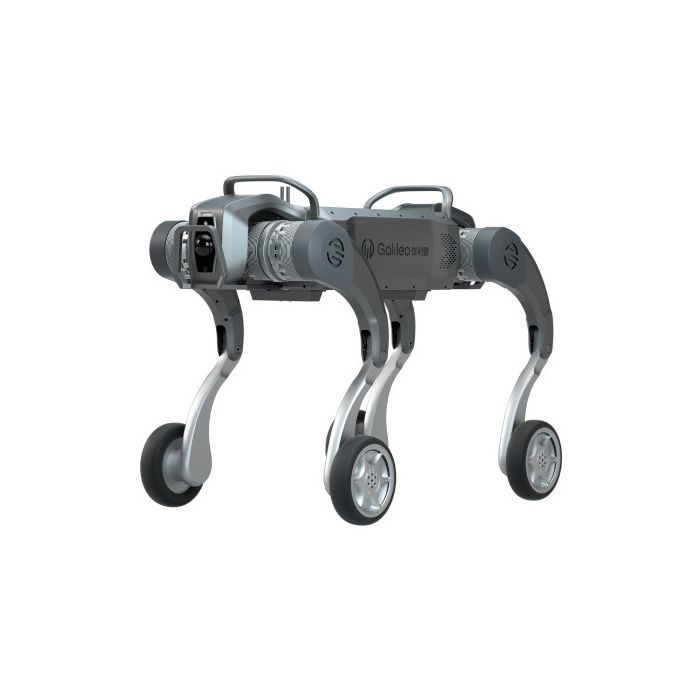
Large industrial sites are mostly flat, with the hard parts scattered in between. A refinery has kilometres of paved access road and then a staircase up to a pipe rack. A logistics park is mostly smooth concrete, apart from its loading docks and curbs. The Galileo S1-W is built for that mix. Each of its four legs ends in a powered wheel. On open ground it rolls at up to 6 m/s. When it reaches steps, a raised platform or broken ground, it walks. It carries the same 100 kg working load as Galileo's flagship S1. It also adds a higher 110 cm platform step-up, so one robot can cover the long stretches and the obstacles on the same route.
Background and Manufacturer
Galileo (Tianjin) Technology builds bionic quadruped robots for industry, public safety and emergency response. Its range runs from the compact C1 through the E1 industrial series and the explosion-protected EX-1 up to the S1 series, its largest legged platform. The S1-W is the wheel-legged member of that series. It sits beside the all-legged S1 and the S1-E for high-risk environments. Galileo pairs most of its quadrupeds with a W variant. The S1-W brings that approach to the heavy-load class.
Design and Engineering
Two ways to move
On smooth surfaces the S1-W rolls on its wheels, which is faster and uses less energy than walking. When the route calls for it, the robot switches to its legs. It climbs consecutive 30 cm steps, takes slopes of 30° or more, and steps up onto platforms as high as 110 cm. That is 30 cm higher than the legged S1. Speed adjusts from 0 to 6 m/s, so the robot can crawl through a tight equipment bay or cross a large yard quickly.
Heavy-duty frame
The robot stands 1,200 × 550 × 760 mm and weighs 128 kg, which is 10 kg more than the S1 because of the wheel drive. It carries 100 kg continuously while moving and holds 170 kg while standing. The standing figure is for static jobs, such as acting as a mobile mount for heavy equipment, and is not a moving load.
Power and endurance
Two lithium batteries provide 60 Ah at 59 V (3,540 Wh), giving 2.5 to 4 hours of operation depending on load, speed and terrain. Galileo rates the runtime more conservatively than the S1's. The wheels pay that back in distance, because more ground is covered per hour of work. The robot supports autonomous charging, so it can dock between rounds without anyone stepping in. Its low-power standby lasts 365 days or more and supports remote wake-up. The charger accepts 100 to 240 V input.
Computing and connectivity
Control runs on a low-power ARM processor (8 cores, 8 GB RAM, 64 GB SSD). A second, x86 processor (4 cores, 8 threads, 16 GB RAM, 256 GB storage) runs perception, mapping, AI models and custom software. Mounted devices connect over Ethernet, USB 3.0 and RS485 and draw power from 48 V and 24 V outputs. All of these interfaces can be expanded. Dual-band Wi-Fi 6 links the robot to the site network, and an app handles operation.
Sealed for the field
The S1-W is rated IP67 against dust and temporary submersion and works from −20 °C to 55 °C.
Technical Specifications
| Parameter | Galileo S1-W |
|---|---|
| Robot type | Wheel-legged industrial quadruped |
| Standing dimensions (L × W × H) | 1,200 × 550 × 760 mm |
| Weight | 128 kg |
| Continuous walking load | 100 kg |
| Maximum standing load | 170 kg |
| Speed | 0 to 6 m/s, adjustable |
| Slope | ≥30° |
| Stairs | 30 cm consecutive steps |
| Platform step-up | 110 cm |
| Battery | Lithium, dual, 60 Ah total (3,540 Wh) |
| Rated voltage | 59 V |
| Runtime | 2.5 to 4 hours |
| Charger input | 100 to 240 V |
| Autonomous charging | Supported |
| Low-power standby | ≥365 days, remote wake-up |
| Payload power outputs | 48 V, 24 V (expandable) |
| Computing | ARM 8C/8T, 8 GB/64 GB + x86 4C/8T, 16 GB/256 GB |
| Interfaces | Ethernet, USB 3.0, RS485 (expandable) |
| Wireless | Wi-Fi 6, dual band |
| App control | Supported |
| Ingress protection | IP67 |
| Operating temperature | −20 °C to 55 °C |
| Warranty | 12 months |
S1-W or S1?
Both robots share the same payload ratings, battery, computing, sealing and temperature range. Choose the S1-W when routes are long and mostly paved, when speed between checkpoints matters, or when the robot needs to get onto loading docks and raised platforms up to 110 cm. Choose the S1 when the ground is rough for most of the route, such as rubble, mud, forest floor or mountain paths, where wheels add little. The S1 is also 10 kg lighter and runs longer per charge.
Who It Is For
- Plant and refinery operators running inspection rounds across large sites with long roads between equipment areas.
- Logistics and warehousing companies moving material between buildings, docks and mezzanines.
- Security organizations patrolling large perimeters, campuses and ports where coverage per hour is what counts.
- Utilities and energy companies working on substations, solar farms and pipeline corridors.
- Emergency services that need to get a heavy load to a scene quickly and then cover the last stretch on foot.
Applications
Long-route patrol: High-speed rolling between checkpoints, with autonomous docking to keep the robot cycling through the shift.
Moving material between sites: Carrying parts, tools and consumables across yards and up onto loading docks and platforms.
Wide-area inspection: Covering large plants with thermal, acoustic, gas and visual instruments powered from the robot's own outputs.
Rapid response: Rushing rescue equipment along roads, then walking it over debris and stairs to where it is needed.
Support: From First Inquiry to Long-Term Service
Before you buy: The support process begins with a look at your routes. That means how much is paved and how much is rough, the step and platform heights, the payload and the mission length. That review confirms whether the S1-W or the S1 is the better fit and settles the payload, power and charging plan before a quote is issued.
Setup and commissioning: The robot ships with manufacturer documentation. First start covers battery charging, calibration of both the wheeled and walking modes, app and network setup, placement of the docking station and checks on mounted equipment.
Training: Operators learn when and how to switch modes, how to handle loads, how to move a 128 kg machine safely, and the daily pre-mission checks. Technical staff learn the computing platform, the interfaces and the power outputs.
Deployment: Support covers mapping routes that mix rolling and walking sections, setting up autonomous charging, integrating payloads, and connecting the robot to monitoring or fleet software.
Ongoing service: The robot carries a 12-month manufacturer warranty. Technical help, software updates, wheel and drive service, replacement batteries and spare parts stay available for the life of the robot.
Pricing and Availability
The Galileo S1-W is sold on quotation. The final cost depends on configuration, mounted equipment, spare batteries, the charging dock, training and integration scope, the delivery destination and import duties. Every unit is sourced through the manufacturer's official channels and comes with full manufacturer warranty, documentation and technical support. You can request quotes for single units, fleets and projects on this page.
Frequently Asked Questions
How fast is the Galileo S1-W?
It reaches up to 6 m/s rolling on its wheels, and the speed is adjustable from a standstill.
What is the difference between the S1-W and the S1?
The S1-W adds powered wheels for speeds up to 6 m/s and a 110 cm platform step-up, against the S1's 3.5 m/s and 80 cm. It weighs 128 kg instead of 118 kg and runs 2.5 to 4 hours instead of 3.5 to 5.
How much can the S1-W carry?
It carries 100 kg continuously while moving and supports 170 kg while standing.
Can it climb stairs?
Yes. It switches to walking for consecutive 30 cm steps and slopes of 30° or more.
Can it charge itself?
Yes. It supports autonomous docking and charging, and it can stay on standby for 365 days or more with remote wake-up.
Is it weatherproof?
It is sealed to IP67 and works from −20 °C to 55 °C.
Where can I buy the Galileo S1-W and what does it cost?
You can buy the Galileo S1-W right here. The price depends on configuration, equipment, integration and delivery destination, and you can request a quote for your project on this page.
Summary
The Galileo S1-W gives Galileo's heavy-load quadruped a second way to move. It rolls at up to 6 m/s on open ground and walks over steps, slopes and platforms up to 110 cm, while carrying the same 100 kg load as the S1. With autonomous charging, IP67 sealing, dual computing and onboard payload power, it is built for operators whose routes are long and only partly rough.