
Galileo EX-1 Intelligent Bionic Explosion-Proof Quadruped Robot
In stock
- BRAND:
- GALILEO
- MODEL:
- EX-1
- ORIGIN:
- China
- Warranty:
- 12 MONTHS
- AVAILABILITY:
- SUBJECT TO AVAILABILITY
- SKU:
- GALILEO-EX-1
Galileo EX-1 Intelligent Bionic Explosion-Proof Quadruped Robot
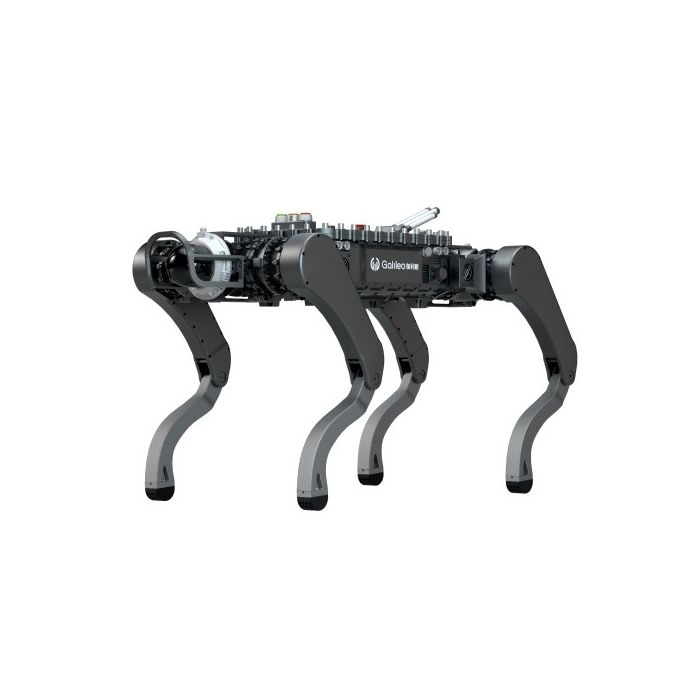
Wherever flammable gas can collect, ordinary electronics are a liability. A single spark or a hot surface can be enough. Refineries, gas plants, chemical works and fuel terminals still need daily rounds in exactly those areas, and for years that meant sending people. The Galileo EX-1 changes that. It is a 120 kg four-legged inspection robot built from the ground up for potentially explosive atmospheres. It carries an Ex IIB T4 Gb explosion-protection marking and IP66 sealing, and it walks the same stairs, gratings and pipe racks as a human inspector. Built by the Chinese quadruped specialist Galileo (GalileoTime), the EX-1 treats hazardous-area compliance as the main design requirement, not an option bolted on later.
Background and Manufacturer
Galileo (Tianjin) Technology develops intelligent bionic quadruped robots for industry, public security and emergency response. Its range runs from the compact C1 through the heavy industrial S1 and E1 platforms to dual-arm mobile manipulators. The EX-1 is the hazardous-area member of that family. It takes the load capacity and terrain ability of Galileo's large industrial quadrupeds and wraps them in an explosion-protected, weather-sealed body for oil, gas and chemical sites.
Understanding the Ex IIB T4 Gb Rating
The EX-1's marking tells a safety engineer exactly where the robot can go.
- Ex means the equipment is built to an explosion-protection standard.
- IIB is the gas group. The robot is suitable for ethylene-type gases and, by extension, for IIA gases such as propane, methane-rich process streams, gasoline vapor and most common hydrocarbons. It is not rated for IIC gases such as hydrogen and acetylene.
- T4 is the temperature class. No surface of the robot exceeds 135 °C, so it is safe around gases whose ignition temperature is above that.
- Gb is the equipment protection level, the high level suited to Zone 1 areas (where an explosive atmosphere is likely during normal operation) and also to Zone 2.
The rating is paired with IP66 protection against dust and powerful water jets and an operating range of −20 °C to 50 °C. Together they suit outdoor process units, tank farms and washdown areas as well as indoor plant rooms.
Design and Engineering
The EX-1 measures about 130 × 65 × 79 cm and weighs 120 kg including its battery. Its twelve joints, three per leg, deliver up to 500 N·m of peak torque. That torque lets it carry a 30 kg working payload, climb 30° slopes and step up 25 cm stairs, enough for typical plant staircases and raised walkways.
Its top speed is 1.0 m/s, which is a deliberate choice. Inspection in a hazardous area rewards steady, controlled movement and stable sensor footage, not sprinting. A 48 V supply backed by a 45.2 Ah (2,160 Wh) battery gives about two hours of continuous work. Auxiliary 48 V and 24 V outputs, expandable as needed, power mission payloads such as gas detectors, thermal cameras or acoustic sensors.
For perception, the EX-1 uses a 3D LiDAR for mapping, localization and obstacle avoidance, plus dual depth cameras for close-range terrain reading and footstep placement. It connects over Ethernet, with 4G supported for remote operation and data backhaul. The platform also supports secondary development, so integrators can add their own inspection logic, analytics and site-system connections.
Technical Specifications
| Parameter | Galileo EX-1 |
|---|---|
| Robot type | Explosion-proof quadruped |
| Dimensions (L × W × H) | 1,300 × 650 × 790 mm |
| Weight (with battery) | 120 kg |
| Degrees of freedom | 12 |
| Peak joint torque | 500 N·m |
| Walking payload | 30 kg |
| Maximum speed | 1.0 m/s |
| Maximum slope | 30° |
| Stair climbing height | 25 cm |
| Supply voltage | 48 V |
| Battery | 45.2 Ah (2,160 Wh) |
| Runtime | approx. 2 hours continuous |
| Payload power | 48 V and 24 V, expandable |
| Perception | 3D LiDAR, dual depth cameras |
| Connectivity | Ethernet, 4G supported |
| Explosion protection | Ex IIB T4 Gb |
| Ingress protection | IP66 |
| Operating temperature | −20 °C to 50 °C |
| Secondary development | Supported |
| Warranty | 12 months |
Who It Is For
The EX-1 is aimed at operators who already work under hazardous-area rules. These include oil and gas producers, refineries, petrochemical and specialty chemical plants, LNG and LPG terminals, fuel depots, pharmaceutical solvent facilities and the engineering contractors who serve them. Emergency services and industrial fire brigades are a second audience. They need a ground robot they can send into a leak scene before the atmosphere has been cleared.
Applications
Routine process-unit rounds: Scheduled walks through Zone 1 and Zone 2 areas to log gauge readings, valve positions and visible leaks. The robot follows the same route every shift, so readings stay comparable.
Leak detection and gas mapping: Paired with a suitable explosion-protected gas sensor, the EX-1 can patrol flanges, pumps and compressors and tie each reading to its LiDAR position.
Tank farms and terminals: Long outdoor patrols around bunds, pipe racks and loading bays in all weather, aided by the IP66 sealing.
Emergency reconnaissance: A first look at a release, fire aftermath or confined area before responders enter. The robot sends back footage and data without putting anyone in the atmosphere.
Shutdown and turnaround support: Extra inspection capacity during maintenance campaigns, when skilled people are fully booked.
Support: From Pre-Sale to Ongoing Service
Pre-sale consultation: Before a quotation is issued, the EX-1's rating is checked against your site's hazardous-area classification. That covers your gas group, temperature class and zones. Your inspection payloads, route lengths and connectivity needs are reviewed at the same time, so the configuration matches the job and the paperwork your safety team will ask for.
Setup and commissioning: Each robot is prepared and delivered with its documentation. Commissioning covers first power-up, battery and charging setup, controller pairing and a functional check of the LiDAR, cameras and communications.
Operator training: Your operators learn the robot's control, mapping, route planning, safe handling and hazardous-area operating procedures. Maintenance staff learn routine checks and the care of seals and enclosures.
Deployment: Site maps are built, inspection routes and checkpoints are defined and payload data is connected to your existing systems. Integration through the secondary development interface is available for teams with their own software.
Ongoing support: Every unit carries a 12-month manufacturer warranty. Technical support, firmware updates and spare parts are provided throughout the robot's service life, along with guidance on periodic inspection so its protection rating stays valid.
Pricing and Availability
The Galileo EX-1 is supplied by quotation. The final cost depends on configuration, mission payloads, extra batteries and charging equipment, training scope, delivery destination and import duties. Every unit is sourced through the manufacturer's official channels and comes with full manufacturer warranty, documentation and technical support. Quotations for the Galileo EX-1, including multi-unit and site-wide programs, are available on this page.
Frequently Asked Questions
What does the Ex IIB T4 Gb rating mean for the Galileo EX-1?
The robot is protected for IIB and IIA gas atmospheres, keeps every surface below 135 °C and meets the Gb protection level suited to Zone 1 and Zone 2 hazardous areas.
Can the Galileo EX-1 work around hydrogen?
No. Hydrogen and acetylene fall in gas group IIC, which is above the EX-1's IIB rating. Sites handling those gases need IIC-rated equipment.
How much can the Galileo EX-1 carry?
It carries a 30 kg walking payload and provides 48 V and 24 V power outputs for mission equipment such as gas detectors and thermal cameras.
Can the Galileo EX-1 climb stairs?
Yes. It climbs stairs up to 25 cm high and slopes up to 30°, enough for typical plant staircases, walkways and outdoor grades.
How long does the Galileo EX-1 run on one charge?
Its 2,160 Wh battery gives about two hours of continuous operation. Actual runtime depends on terrain, payload and how many sensors are active.
Is the Galileo EX-1 weatherproof?
Yes. It is rated IP66 against dust and powerful water jets and operates from −20 °C to 50 °C, so it suits outdoor process units and tank farms.
Where can I buy the Galileo EX-1 and what does it cost?
You can buy the Galileo EX-1 right here. The price depends on configuration, payloads, training and delivery destination, and you can request a quotation for your exact setup on this page.
Summary
The Galileo EX-1 brings legged mobility to the parts of an industrial site where people are most at risk. Its Ex IIB T4 Gb protection, IP66 sealing and 500 N·m joints let it climb stairs, carry 30 kg of sensors and walk inspection rounds through classified areas in heat or frost. Pre-sale area matching, commissioning, training and long-term support come with it. For refineries, chemical plants, terminals and industrial emergency teams ready to take people out of the hazardous zone, this page is the starting point.