Technology and Specifications
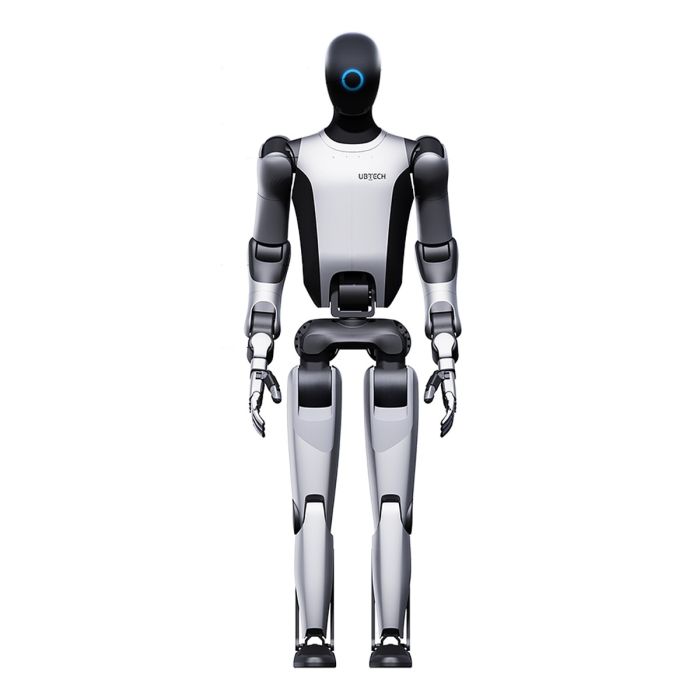
The Walker S2 integrates advanced artificial intelligence, perception systems, and connectivity to function as an autonomous industrial agent.
Core Technologies
-
AI and Task Planning: The robot operates on UBTech’s proprietary BrainNet 2.0 architecture and the Co-Agent system. This dual-loop AI framework combines task-driven decision-making with continuous environmental feedback, allowing the robot to adapt to new situations, perform multi-step execution, and coordinate with other robots .
-
Perception and Vision: Walker S2 uses a "human-eye" binocular stereo vision system. This setup utilizes dual RGB cameras and deep learning-based depth estimation to generate real-time, high-precision depth maps of its surroundings. This enables accurate object recognition, spatial awareness, and safe navigation in dynamic environments . It is supplemented by a fish-eye camera for wide-angle spatial orientation and an inertial measurement unit (IMU) for balance .
-
Connectivity: The robot is designed for Industry 4.0, supporting Wi-Fi 6, Bluetooth 5.2, and optional 5G connectivity. This allows for seamless integration with other automated systems like autonomous forklifts and logistics vehicles, as well as real-time data streaming and fleet management .
Key Specifications
Sources:
Applications and Use Cases
The UBTech Walker S2 is primarily positioned as an industrial automation tool, with its capabilities being validated by global manufacturing leaders.
Smart Manufacturing and Assembly
Walker S2 is deployed on production lines for tasks such as precision component handling, adaptive assembly, and quality inspection. Its human-like form allows it to operate in workspaces originally designed for humans, performing repetitive or ergonomically challenging tasks .
-
Automotive and Electronics: Companies like BYD and Foxconn have integrated Walker S2 units into their facilities for material handling and assembly tasks .
-
Aerospace: In a landmark deal, Airbus purchased Walker S2 robots in early 2026 to explore their use in aircraft manufacturing. The collaboration aims to utilize the robot's precision for tasks like drilling and inspection on assembly lines, where safety and accuracy are paramount .
-
Semiconductor: Texas Instruments has also been testing the Walker S2 on its production lines, demonstrating its applicability in high-precision, cleanroom-like environments .
Logistics and Warehousing
The robot's mobility and payload capacity make it suitable for logistics tasks, including box handling, loading and unloading bins, and navigating multi-level storage systems. Its ability to coordinate with autonomous logistics vehicles enhances the flexibility of warehouse automation .
Industrial Inspection
In environments like the 5G-enabled wind turbine plant operated by SANY RE, Walker S2 performs autonomous patrols and inspection tasks, using its vision systems to monitor equipment and ensure operational safety .
Advantages / Benefits
The Walker S2 offers several distinct advantages for businesses looking to automate their operations:
-
Continuous Operation (24/7): The autonomous battery-swapping mechanism is the most significant differentiator, as it removes the traditional downtime associated with recharging. This allows for non-stop deployment in high-throughput manufacturing environments .
-
Human-Centric Design: By mimicking human proportions and movements, the robot can be deployed into existing workspaces without expensive infrastructure overhauls. It can use the same tools, stairs, and passageways as human employees .
-
High Precision and Payload: With the ability to handle up to 15 kg per arm and perform sub-millimeter manipulations, it bridges the gap between heavy-duty industrial robots and delicate collaborative robots (cobots) .
-
Intelligent Adaptability: Powered by the Co-Agent AI system, the Walker S2 is not just a pre-programmed machine. It can perceive its environment, make real-time decisions, and adapt to variations in its tasks, making it suitable for complex, unstructured industrial settings .
Comparisons
In the rapidly evolving humanoid robotics market, the Walker S2 holds a unique position. Compared to Boston Dynamics' Atlas, which focuses on acrobatic mobility and research, the Walker S2 is tailored for practical, repetitive industrial labor. While Agility Robotics' Digit is optimized for logistics and box handling in warehouses, the Walker S2 offers a broader range of full-body motion and higher payload capacity for manufacturing tasks .
UBTech's primary competition comes from other Chinese firms like Unitree and Agibot, as well as Tesla with its Optimus robot. However, the Walker S2's early deployment with global giants like Airbus, Foxconn, and BYD, combined with its autonomous charging feature, gives it a competitive edge in real-world validation and continuous operation capabilities .
Pricing and Availability
The UBTech Walker S2 is an enterprise-grade product, and pricing reflects its industrial capabilities.
-
Pricing: The estimated price for a single Walker S2 unit is approximately US$112,000 . This price point is expected to decrease as UBTech scales production, targeting 5,000 units in 2026 and 10,000 units in 2027 .
-
Availability: The robot is available for purchase by industrial clients, typically through direct negotiation with UBTech or authorized integrators. Delivery times can range from 5 weeks to 6 months depending on configuration and order volume . As of late 2025, UBTech reported orders totaling 1.4 billion yuan ($201 million), indicating strong market demand .
FAQ Section
What is the UBTech Walker S2?
The UBTech Walker S2 is a next-generation industrial humanoid robot designed for smart manufacturing, logistics, and service environments. It is notable for its human-like 52-degree-of-freedom movement, advanced AI for autonomous task execution, and a unique ability to swap its own batteries for continuous operation .
How does the Walker S2 robot work?
The Walker S2 works by combining its physical hardware (52 DOF, sensors) with a central AI system called Co-Agent. It perceives its environment using binocular stereo vision cameras, plans tasks using AI models, and executes movements with dynamic balance control. When its battery is low, it navigates to a station and performs a mechanical routine to swap the depleted battery for a charged one .
Why is the Walker S2 important for industry?
The Walker S2 is important because it addresses two major challenges in robotics: autonomy and endurance. Its autonomous battery swap enables 24/7 productivity, and its human-like design allows it to fit into existing factory setups. This makes it a practical tool for automating repetitive, precise, or physically demanding tasks in real-world industrial settings .
Where can I buy the UBTech Walker S2?
The Walker S2 is an industrial robot sold directly to businesses. Interested companies should contact UBTech Robotics directly through their official website or work with authorized industrial automation integrators. It is not typically sold through consumer retail channels .
What are the benefits of using the Walker S2?
The benefits of the Walker S2 include: 1) 24/7 Uptime due to autonomous battery swapping; 2) High Precision with payloads up to 15kg; 3) Seamless Integration into human-centric workspaces; 4) Intelligent Flexibility to adapt to varying tasks on assembly lines; and 5) Scalability for large-scale smart factory deployments .
Summary
The UBTech Walker S2 represents a pivotal advancement in the field of commercial humanoid robotics. By solving the critical problem of power management through its autonomous battery-swapping system, it has moved beyond the prototype phase to become a viable tool for continuous industrial use. With its combination of human-like dexterity, advanced AI-driven perception, and robust mobility, the Walker S2 is already being deployed by global leaders in aerospace, automotive, and electronics manufacturing. As UBTech scales production, the Walker S2 is well-positioned to play a major role in the ongoing transformation toward intelligent, automated, and flexible smart factories worldwide.